Let your mind wander in simplicity, blend your spirit with the vastness, follow along with things as they are, and make no room for personal views – then the world will be governed.
-Zhuangzi
The path of practice described in this guide is referred to with various names such as prajñāpāramitā, non-production, or simply returning to simplicity. I hope that this guide will point out how immediately accessible this valuable practice can be.
Return to simplicity
Returning to simplicity points to rediscovering and deepening our innate connection with nature and intuitive wisdom. To better understand what is meant by returning to simplicity, it may be helpful to explore three core concepts drawn from Chinese spiritual traditions.
- Wuwei
- Ziran
- Weiwuwei
Wuwei might be thought of as absence of action.
Ziran means natural, or arising of it’s own.
Weiwuwei is intuitive action or to act in harmony with nature.
The interplay of these three concepts can flow together into a return to simplicity that leads to the profound way of living that is referred to as returning to nature.
Laozi’s description
We can find a detailed description in the 16th section of the Daodejing.
Empty yourself of everything.
Let the mind become still.
The ten thousand things rise and fall while the Self watches their return.
They grow and flourish and then return to the source.
Returning to the source is stillness, which is the way of nature.
The way of nature is unchanging.
Knowing constancy is insight.
Not knowing constancy leads to disaster.
Knowing constancy, the mind is open.
With an open mind, you will be openhearted.
Being openhearted, you will act royally.
Being royal, you will attain the divine.
Being divine, you will be at one with the Tao.
Being at one with the Tao is eternal.
And though the body dies, the Tao will never pass away.-Laozi
These three concepts are woven into these verses.
- Wuwei (absence of action, resting into being)
- Empty yourself of everything.
Let the mind become still.
- Empty yourself of everything.
- Ziran (growing sensitive to what is arising of it’s own)
- The ten thousand things rise and fall while the Self watches their return.
They grow and flourish and then return to the source.
- The ten thousand things rise and fall while the Self watches their return.
- Weiwuwei (acting in harmony with what is unfolding, transformation occurs naturally)
- The way of nature is unchanging.
Knowing constancy is insight.
Not knowing constancy leads to disaster.
Knowing constancy, the mind is open.
With an open mind, you will be openhearted.
Being openhearted, you will act royally.
Being royal, you will attain the divine.
Being divine, you will be at one with the Tao.
Being at one with the Tao is eternal.
And though the body dies, the Tao will never pass away.
- The way of nature is unchanging.
Sailing
We might explore these concepts through an analogy of a sailboat.
Picture that we are in a sailboat equipped with a motor. This boat is out on a large body of water and is currently motoring towards its destination.

If we turn off the motor this is wuwei.

With the motor turned off we become aware of the natural existing conditions, like the strength and direction of the wind, the size of the waves, and the currents of the water. These natural conditions are ziran.

Putting up the sails, we feel and work with the existing conditions. This also includes observing how sailing is going and what destination makes sense considering the conditions that are present. This skillful sailing according to conditions is weiwuwei.
This is like a boat following a current downstream. Though you can say that it moves, the boat is at rest and there is no trace of movement. This is called ‘moving without moving.’
-Issai Chozanshi
What does sailing have to do with practicing Dharma? The words “Dharma” and “Tao” both describe a deep study of the unfolding of nature. This approach to life where conditions are observed, accepted and considered, can allow for skillful sailing throughout life.
Pushing through life
Let us expand on how each of these three terms applies outside of the boat analogy.
Many of us have developed the tendency of leaning forward through life. By leaning forward, I mean our tendency to go through life pushing towards our goals. In this way of living, we regularly aim our efforts at where we think life should go next. The goal may be anything from a car, finding a partner, career changes or even seeking spiritual realization. Willfully trying to push forward, each goal is seen as the next step of life, with the time and effort it takes to reach each goal being perceived as at best, a formality, or as time we wish we didn’t have to waste.
In this model, the reward is felt to be at the goal, and everything leading up to the goal tends to be seen as an inconvenient price that must be paid in order to try and reach the goal. Changing conditions are seen as obstacles and people and events that lead away from the goal are perceived as if they are enemies. We feel we must get past them to reach our goals.
Working with the three concepts
A good traveler has no fixed plans, and is not intent on arriving.
-Laozi
Wuwei, ziran and weiwuwei weave together in a different manner. To learn from them we must be willing to explore setting down this habitual mode of pushing our way through life and to grow sensitive.
How can we go about this?
We can begin by pausing.
Find some time to explore setting down aim and ambition. By leaning towards our destinations and goals, we have ignored and “motored through” many of the opportunities and conditions that have come along. We are so used to doing that we are not used to making time for simply being.
Resolve to turn off the leaning and motoring, to rest into being, without purpose or expectation. This is wuwei. Make space regularly for unstructured time that has no purpose or expectation tied to it. This space is where the workings of nature can more easily reveal themselves.
While resting in wuwei, ziran is to grow sensitive to the conditions that pushing through life was covering up; sensing what forces are present. Eventually a sense also develops of whether conditions seem to be building or declining.
Examples include:
- The needs and inclinations of the body
- Present and potential opportunities for ourselves and others
- Energy levels and present motivations as well as what is feeding them
- Naturally arising thoughts, memories, impulses, moods and intuition
- Unfolding priorities
Remaining sensitive to the currents of life, weiwuwei is to make an art out of exploring and living in harmony with what is taking place.
Instead of the prior habit of aiming and ignoring, life transforms as the ability develops to artfully accept whatever appears; to discover ways to live that are a good fit based upon how life unfolds.
There is timing in the whole life of the warrior, in their thriving and declining, in their harmony and discord. Similarly, there is timing in the way of the merchant, in the rise and fall of capital.
All things entail rising and falling timing. You must be able to discern this.
-Miyamoto Musashi
Small-mind and big-mind
Within Buddhist teachings we also find the terms small-mind and big-mind.
Small-mind is the experience of interpreting life from the perspective of a separate individual. Here nature seems to be what happens “outside” and we seem to be an independent element or agent that acts apart from nature, with a mind that is “inside”. The perspective of small-mind causes thoughts, ideas and memories to be woven together into a sense of self.
If we are not careful we may live out the majority of life from this limiting perspective.
Big-mind is the realization that all experience is equally part of one fabric. No separation of “mind” can be found, there is just the integrated fabric of reality. Mental content, birth, the events of life, and death are all just changes that play out within the natural function of this boundless grand system of Dharma or Tao as it operates. No experience of self can be found.
The bodies, thoughts and experiences in our lives are seen to have a similar relationship to nature as cells do to a body, each having separate functions yet participating as an intelligently operating whole.
Starving small-mind
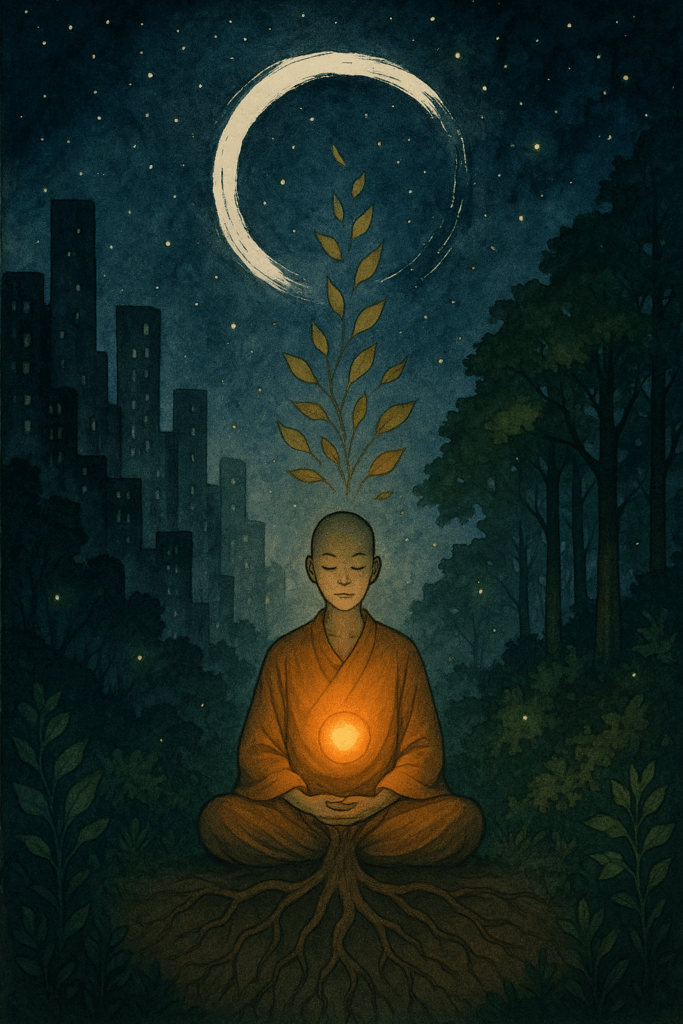
Wuwei starves the activities that build the sense of small-mind. As the position of wuwei is maintained natural balance and sensitivity arise on their own.
This can be practiced as a formal meditation. One method is presented below.
- Set a timer for the amount of time set aside for practice.
- Sit into a posture that allows for a comfortable, stable base and a relaxed-but-alert, upright spine.
- You may stay upright and unsupported, or you may rest back onto something supportive if you prefer.
- Allow the body to naturally settle down into the surfaces that support it.
- Deeply relax the face and the entire body, refuse to do anything on purpose.
- Remain like this until the time for practice concludes, not holding any goal or expectation.
- The senses will grow sensitive and operate freely without any effort whatsoever.
Regularly cultivate this skill of deep letting go. Resolve to stay with the practice to its conclusion regardless of what comes up. This may challenge ideas we tend to hold around spiritual practice, especially around sleepiness, restlessness and letting mental activities operate without management. Simply let natural function become the teacher.
Heaven and Earth unwinding
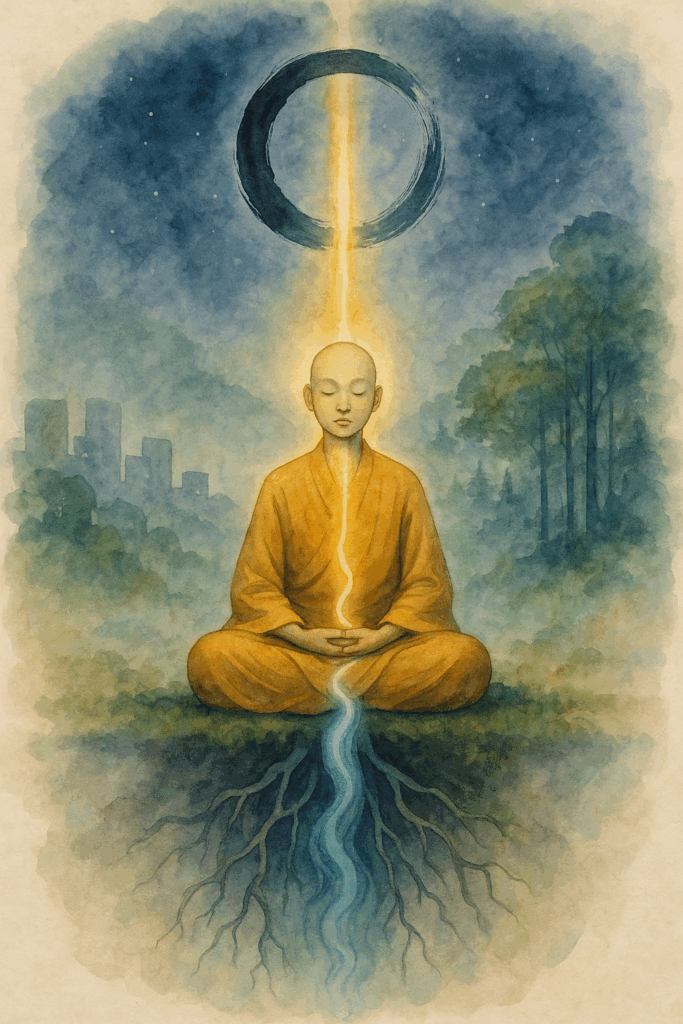
Here is another practice that can also lead into profound connection with nature and simplicity.
- Sit into a posture that allows for a comfortable, stable base and a relaxed-but-alert, upright spine.
- Allow the body to naturally settle down into the surfaces that support it.
- From this settled place, let the crown of the head float upwards, growing taller.
- The two forces drawing towards heaven and earth should be continually experienced by remaining sensitive to the body.
- Continually experience this feeling of the body being drawn between settling down at the bottom, and floating upwards at the top. Allow the spine to be drawn gently along its length and maintain this feeling.
- While the spine is drawn along its length, allow any adjustments of the postural system to happen spontaneously and whenever they arise. Tuning into and allowing this process is allowing a sort of unwinding to play out.
- As unwinding is allowed to run its natural course, the experience will increasingly settle into clarity through unwinding into inaction.
Practice often and learn how to let this simple experience of remaining sensitive to the body and its needs, regardless of what comes along, become a way of living.
Not just a meditation
Returning to simplicity is not just a formal seated meditation, this is a way of approaching all of life.
The meditation practices reveal, connect with, and help us learn from nature.
By refraining from feeding the “making busy” activities of small-mind, and remaining sensitive to the content of our lives, an amazing connected way-of-going-about-things manifests dynamically.
Cleaning dishes
Let’s take putting away and cleaning dishes as an example.
The first step is to simply pause and drop any agenda being held for the next moment.
This can be done by letting the sensory experience be known without thought eclipsing the rest of what is sensed.
Now, growing sensitive, we notice that there are dishes that need to be cleaned.
Instead of leaning into a distraction or forming an opinion about the dishes, simply notice things like:
- Where are they?
- What needs to happen?
There is no need to add ideas about how long cleaning and putting away dishes will take or how the process will go.
Gather the dishes in whatever order plays out and carry them to the sink. Sensitive to the sounds, smells and sensations of gathering the dishes, notice how fascinating it is that the route taken to get the dishes just sort of comes together. No need to judge it for efficiency, just let however it is be good enough.
With the dishes in the kitchen, open up the dishwasher. As the door is opened it is noticed that it’s full of clean dishes.
A realization comes up naturally.
“The dishwasher is full. “
The previous plan to put the gathered dishes in the dishwasher is dropped. Leave the gathered dishes in a place that seems safe and begin to grab some clean dishes and put them away.
As with gathering the dishes, don’t worry about what order this happens in. Just the act of going through the process with presence will result in the process evolving and improving without any need to think about it. Simply do it remaining sensitive to how it goes.
The last of the clean dishes are unloaded and put away. Due to being present we notice that we are now in the kitchen and there are dirty dishes gathered there, as well as an empty dishwasher.
Another realization pops up.
“The dirty dishes can go in the dishwasher”
Let the hands go to whatever dishes they are drawn towards, picking them up, feeling the textures, hearing the sounds, smelling the smells. Put them in to the dishwasher in whatever way they end up loaded. Throughout this process realizations will arise around what makes sense and what might be problematic. As these arise, let adjustments be made until things seem ok.
“The dishes are in the dishwasher.”
An idea arises.
“Usually the dish cleaning supplies for the dishwasher are under the sink.”
Walking over to the sink, check if there are dishwasher cleaning supplies there.
“There they are.”
Let the hands grab some and put it in the dishwasher, getting it ready to operate. Now it seems it would be good to shut it and turn it on. Let that happen, sensitive to the experience.
The dishwasher is now loaded and running, the clean dishes that were in it have been put away as well.
“That feels nice.”
The dishes were just done without forcing ourselves through the process. The learning process of how it went happened naturally and was interesting. How it might happen next time is a fun mystery.
Going about this, and the rest of life in this way, how things are done naturally evolves. An art of doing the dishes can reveal itself, as can an art of going through each day.
Realizing big-mind
When the faculties of officiating understanding come to rest, imponderable spiritlike impulses begin to stir.
–Zhuangzi
Realizing the shift from small-mind to big-mind is a natural side effect of living in harmony with the concepts of wuwei, ziran and weiwuwei.
The leaning forward through life that we have been habitually doing might be likened to a cell that is operating independently from the signals the body offers. While still a part of the body, this way of operating results in disharmony and is not a good fit for either the body or the cell.

By sensitizing to life and operating in harmony with what occurs, we begin to take part in the grand workings of the universal body. As this way of living gains momentum it takes less and less effort to live harmoniously, and we find that what we used to micromanage begins to work out on its own without all of the hustle and worry.

Remain sensitive to what is occurring. Let this sensitivity grow expansive and inclusive.
Living like this, impulses, memories, thoughts, moods, etc. will arise on their own. There is no need to generate them on purpose.
Let these be enough, serving as the pool of choices that actions are selected from. If no wise choices surface in a particular situation, simply notice none of what arose seemed a good fit and wait to see what else surfaces.
A wonderful new system of living will be uncovered, that of living connected to the universal body of nature. Mental activity is experienced just like the other senses are, without the interference of thought. Ordinary life grows increasingly simple and wonderous.
This sets into motion a continually deepening process of connecting to and returning life and our function to nature. As this process cascades, we find many of our assumptions and vexations are simply forgotten or cease to be constructed.
Clarifying their eyes, they do not look; quieting their
ears, they do not listen. Closing their mouths, they do not
speak; letting their minds be, they do not think. Abandoning
intellectualism, they return to utter simplicity; resting their
vital spirit, they detach from knowledge. Therefore they
have no likes or dislikes. This is called great attainment.– Wenzi
Misunderstood throughout the ages
Silent Illumination, just sitting/shikantaza, fasting the heart-mind, sitting and forgetting, these are some of the names of crowning practices within Buddhism and Taoism. Unfortunately, a long history of dismissal and misunderstanding surrounding these practices has been present throughout history, and this still persists to the common day. These views come about largely due to the lack of experiential understanding around the roles and functions that wuwei, ziran and weiwuwei play in spiritual practice.
The entangled perspective rooted in small-mind cannot fathom how anything wise can be accomplished without concepts and intentional doing leading the way. Small-mind understands life from the perspective of a self at the center doing and experiencing it all.
There is another way, and it is quite amazing.
How do they work?
To uncover the amazing way these practices work, two things must be present and come into balance.
- Embodied experiencing that happens without effort
- Mind operating not-on-purpose
The trick is that we must allow mind to operate completely not-on-purpose. Mind has an effortless, naturally-managed way of functioning that occurs when thoughts are not intentionally created, sustained, stopped or prevented.
This naturally operating mind begins functioning wisely when continuously informed by the senses. This is the role of embodied experiencing.
Mind operating not-on-purpose, senses operating without effort or directing them. This is the magic formula.
With embodied experience informing the natural functions of mind, wise responses, ideas and memories occur on their own. Each arises mysteriously and independently, and since they are not woven together by the perspective of small-mind, the sense of self is not created while mind operates in this fashion.
At first, embodied experiencing may feel like it takes effort. If this seems to be the case, just use less and less effort. Over time it will be revealed that hearing, seeing, feeling, etc. occur quite satisfactorily on their own.
If outside the temple a dog barks, you know it’s a dog; if a crow caws, you know it’s a crow. Even though you’re not deliberately trying to hear or not to hear these different sounds, you recognize each one the moment it appears, and this is proof of the Buddha Mind, unborn and marvelously illuminating.
-Bankei
Where do wuwei, ziran and weiwuwei fit in to all of this?
First, cease directing or controlling thoughts, impulses and mental activities. Let mental activities operate completely not-on-purpose. This is wuwei.
So long as wuwei is maintained, the senses will operate automatically and without complication. Sounds will be heard, sights seen, touches felt, all without effort or willful directing. This naturally arising embodied experiencing is ziran showing itself. Appropriate thoughts, impulses and mental activities will arise on their own, not-on-purpose, based on the embodied experience.
It is important to point out here that there is a difference that must be learned and attuned to, between mental activities that arise out of wuwei and ziran, and those that come up due to operating from the entangled perspective that comes from small-mind. We must be willing to completely give up the activities of small-mind whenever they are detected, and to instead let wuwei and ziran become the priority.
As wuwei continues, the senses become increasingly vivid and run together into one undifferentiated experience. Thoughts and increasingly appropriate responses arise on their own based on the moment-to-moment embodied experience. Ziran can manifest freely due to wuwei. These naturally arising ways of experiencing and responding are then allowed to create the path of our life as well as our responses, all without any conscious agenda. This act of turning everything over to natural simplicity and living in the result is weiwuwei.
If meditation feels tiring, something is wrong – it means you are practicing in the wrong way. True meditation brings ease and clarity, not tension or strain.
-Sayadaw U Tejaniya
On-purpose mind requires constant effort and wrangling. It habitually produces thoughts and mental activities that we mistakenly fuel. They link together, proliferate and “boil over”, or take over the experience.
Mind not-on-purpose paired with embodied experiencing of what is taking place comes together into a naturally self-managing system of operation. Mind regulates itself, produces increasingly wise responses to experience, all without effort and without a conscious agent or driver.
All throughout our lives we have used effort to try and stop ourselves from boiling over, or perhaps at times we have used effort to participate in it.
When this naturally self-managing system is allowed to operate, mind becomes like a pot that no longer is capable of boiling over.
Practice instructions
When you direct your mind toward it, you’ve gone astray; how much more so if you use words to describe it? What if ‘not directing one’s mind’ were it? Why is anything the matter? Take care!
-Yunmen

Practice while sitting
- Settle the body into heaven and earth alignment.
- Legs comfortable and stable, knees level with or lower than the hips.
- Settling and releasing tension into earth, the crown of the head floats up toward the sky, the spine is lengthened.
- Hands close to the body, softened, not pulling the shoulders forward.
- Shoulders settled.
- Chin dropped down and back so the back of the neck grows longer and the crown of the head grows taller.
- Jaw and tongue softened, teeth not quite touching.
- Eyes and face softened, vision unfocused.
- Embodied experiencing, continually feel the sense of touch. The sense of touch will expand to include all of the senses over time.
- Let this happen less, and less, and less on-purpose.
- Let all thought and mental experience operate not-on-purpose, without control, coming and going freely.
- If controlling thought happens, simply return to letting all thought happen not-on-purpose and rest in embodied experiencing.
- Over time embodied experiencing evolves, the feeling of the body and its borders or sense of separation from the environment may dissolve.
- Experience without separation, not-on-purpose.
Practice while standing or moving
- Settle the body into heaven and earth alignment.
- Legs comfortable, settled and stable as you stand or walk.
- Settling and releasing tension into earth, the crown of the head floats up toward the sky, the spine is lengthened.
- Hands and arms softened.
- Shoulders settled.
- Chin dropped down and back so that the back of the neck grows longer and the crown of the head grows taller.
- Jaw and tongue softened, teeth not quite touching.
- Eyes and face softened, vision relaxed, focusing will happen naturally as needed.
- Continuous embodied experiencing. The sense of touch which will expand to include all of the senses over time.
- Let all thought and mental experience operate not-on-purpose, without control, coming and going freely.
- If controlling thought happens, simply return to letting all thought happen not-on-purpose and rest in embodied experiencing.
- Over time embodied experiencing evolves, the feeling of the body and its borders or sense of separation from the environment may fade or evolve.
Stay with the practice and let it evolve over time.
Once every sort of mental process has ceased, not a particle of karma is formed. Then even in this life, your minds and bodies become those of a being completely liberated. Supposing that this does not result in freeing you immediately from further rebirths, at the very least you will be assured of rebirth in accordance with your own wishes
-Huangpo