Awakening Alchemy is a system of body, breath, energy, and spirit practices that cultivate and transform our being on multiple levels. Its concepts and approach are rooted in principles found within East Asian medicine, Taoist cultivation, and Buddhism.
Through ongoing cultivation in this system, sensitivity and capacity for many practices raises.
To begin to understand the system it will serve us well to establish the foundational components and principles.
The Three Treasures
The three treasures (jing, qi, and shen in the Taoist sources) are three layers of experience. Each has its own feel, and together they make up the experience of the living person. When they are healthy and in balance, we tend to feel vibrant and vital energy is strong. When depleted and out of balance, we tend to feel misaligned and unable to realize our potential.
For our purposes we divide the three treasures as follows:
Essence (jing): the generative force, base inherited vitality, hormones, blood, reproductive fluids, bone marrow, and the somatic and visceral layer of experience.
Energy (qi): breath, emotion and emotional content, and energetic experience. Often felt as a blend of the physical and the energetic.
Spirit (shen): the clarity and brightness of awareness itself. When spirit is healthy, we feel awake and clear, and our attention rests easily where it is placed.
Various practices and activities can fortify or deplete one or more of the three treasures. In this system we set up conditions that help replete them and restore them to vibrant function. This raises capacity all across life, not only in spiritual practice.
Attention Leads Energy, Energy Leads to Response
Another important principle within the system is:
Attention and intention lead energy. Energy leads to physical response.
Where attention is clearly and repeatedly placed, energy is eventually drawn. If this persists it will result in physical effects. In the body, this often shows up as changes in sensation and blood flow.
This principle is why the placement of attention matters so much in this system, both in what we do and in what we avoid. The next two sections describe each in turn.
Heaven, Earth, Person
In the Awakening Alchemy system we undertake many of our formal practices working with the model of heaven, earth, and person. This is not a set of ideas to think about so much as a group of experiences to be explored directly.
For now, think of them as follows:
Heaven: that which animates, yang qi intensive. Posturally: the crown of the head rises toward the sky.
Earth: that which would remain if the animating force of life dissipated, yin qi intensive. Posturally: the body settles toward the ground.
Person: the entirety of the experience of that which animates and that which is animated. Posturally: the continual experience of the crown drawn toward the sky, the body settling, and the sensations that arise along with the space they take place within.
Fire and Water
Fire and water are also integral to the imagery and experience of working in this system.
Fire: attention and intention, often tied to the heart center in the chest.
Water: the organs and tissues that tie into vitality and procreation in East Asian medicine. In felt experience, this includes the breasts, the kidneys, and the belly from the navel to the pelvic floor.
The fire should co-mingle with the water. When fire and water are balanced and commingled in a healthy and consistent fashion, a kind of “steam” is produced. This transformative steam circulates around and through our systems, opening and restoring function across the three treasures. As this occurs, the experience moves toward natural, unentangled function. In Buddhist terms, this is the ground from which samatha and vipassanā arise on their own. This unentangled function is not so much created as it is uncovered.
Keep Attention Out of the Head
Please do not intentionally place attention on or in the head during these practices. Sustained concentration in the head can lead to problems, and some of these problems can be very difficult to sort out. If you notice attention gathering in the head, let it drain downward with the exhale and re-establish the felt sense of the lower body and the ground.
Two clarifications, so that this instruction does not appear to conflict with others in this guide:
In the posture work, the crown rising toward the sky is a structural feeling of lift sensed through the whole body. It is not a point of focus held in the head.
In the post-practice massage, the hands pass briefly through the face and scalp on their way down the body. This is moving touch that leads attention and energy downward. It is not sustained attention held in the head.
If Difficulties Arise
As with all techniques, these practices affect each person differently. If you experience problematic symptoms or stress while practicing, please discontinue the practice and consult your teacher, along with a skilled practitioner of traditional East Asian medicine as needed.
Ethical Living and Minimizing Leaks
Within the practice of Awakening Alchemy we aim to grow sensitive to each of the three treasures and to replenish them. This also requires developing a lifestyle built around minimizing the leaks that deplete them. Deeply living and exploring ethical conduct and the Buddhist precepts therefore forms a vital link in this system of practice. Without this component, work with the three treasures is very likely to outflow into vices and the pursuit of sensual pleasure, which weakens the system and can damage spiritual capacity. This can be quite harmful.
When approached skillfully and ethically, the treasures grow and shine. As they grow more vibrant and come into balance, the capacity for liberating Dharma practice often increases. Practices that once felt inaccessible or dry can become tangible and alive.
The role that ethics, virtue, and the prevention of leaks play in this system cannot be overstated.
Posture
Practitioners in this system should pay special attention to developing the seated and standing postures. When the posture is correctly organized, it sets up favorable conditions for the awakening alchemy work to unfold naturally. When possible, organize the body as follows before each practice.
If seated: Begin with the legs in a stable and safe-feeling position. The knees should be level with or below the hips.
If standing: The feet should be stable and roughly shoulder width. The legs should be slightly bent, as if standing in a boat.
In either position:
- Align the spine in heaven, earth, and person. The crown of the head rises toward the sky as if magnetically drawn upward, lengthening the spine. The rest of the body settles downward toward the earth in line with gravity. The experience of the person is the continuous feeling of both, sensed through touch.
- Place the hands close to the body so the shoulders are not pulled forward. The hands can rest relaxed and natural, palm up or palm down, or in a mudra. If using a hand mudra, those that connect one hand with the other and encourage sensitivity generally work best.
- Inhale, contracting and raising the shoulders up by the ears. Exhale as a sigh and drop the shoulders, letting them find their natural resting place.
- Fine-tune the chest and head. Lift the chest gently, making a bit more room for the heart and lungs. Drop the chin slightly, lengthening the back of the neck and opening the area where the neck meets the base of the skull.
- On an inhale, yawn, engaging the jaw and tongue. On the exhale, leave the teeth not quite touching, with the tongue natural in the mouth. The tongue can rest with its tip gently touching the upper palate behind the front teeth, or relax into the floor of the mouth. The tip of the tongue gently touching the upper palate is called the “magpie bridge.” The magpie bridge helps energy that rises to descend and circulate more easily, and it plays a particular role in Phase 3 below.
- Soften the gaze, the eyes, the tissues around the eyes, and eventually the whole face. Take no focus with the gaze. Let the lids continually decide how open or closed to be, based on feel.
Whether sitting or standing, feel the whole body in this shape. Intuitively make gentle adjustments in service of settling into this shape for the duration of the practice period.
Session Length and Frequency
Regularity matters more than duration. A short session practiced most days does more for the treasures than a long session practiced occasionally, and it is far less likely to produce strain.
Beginning practitioners generally do well with fifteen to twenty minutes, extending the session only as the posture becomes comfortable and settling comes reliably. If a session begins to feel forced or effortful, it has gone on long enough. Specific session length, frequency, and time of day are best set with your teacher, who can adjust them to your constitution and circumstances.
Wise View
The correct method for all phases is to directly experience and develop understanding around what Buddhism calls wise view:
Nothing should be taken as I, me, or mine.
This especially includes thoughts, memories, feelings, moods, impulses, and mental activity.
Let thoughts come and go freely while practicing. Thought does not have to be seen as an obstacle, just something that happens to be present or not while practice is taking place. Make no problems or stories. Work sensitive and curious within what is occurring.
Three Core Phases of Practice
We develop and work with three core phases of practice in this system. Develop each phase to some depth before moving to the next; signs of readiness are given with each phase. Once proficiency exists in all three, we learn to move intuitively among them based on the situation and what feels appropriate.
Each phase can address the three treasures in different ways. Broadly, Phase 1 restores essence, Phase 2 works most directly with energy, and Phase 3 opens toward spirit, though in practice every phase touches all three. By continually developing and remaining sensitive to the experience of each phase, we become attuned to what is needed and how best to address it.
Phase 1: Deep Settling

Settle until the pilot light ignites. Yang energy is born from yin stillness.
Experience breathing and settling, as quiet and comfortable as the moment allows, until a small warmth of vital energy, the pilot light, is born out of the settled space. The pilot light is not made or hunted for. It arises on its own when settling is genuine.
Signs of readiness for Phase 2: settling comes reliably in most sessions, and the pilot light arises on its own without being sought.
Phase 2: Warrior Fire

Gather, tend, and steam the warmth born from settling, continually feeling sensation and breath pulsation at the dantian.
This phase is performed after the pilot light has appeared, or when distinct energies or entanglements feel present. Through continuous gentle mindfulness, the warmth is drawn to the appropriate dantian, where the fire is tended and intensifies, melting what it gathers into a neutral “steam.”
A note on placement: following the traditional sources, men in this system generally work at the lower dantian in the lower belly, and women at the heart center. This distinction comes from the women’s alchemy (nüdan) teachings, which holds that the heart center is the more direct working ground for women’s cultivation. It is a starting orientation, not a law. If direct experience clearly and consistently suggests a different placement for a given practitioner, this should be explored together with a teacher rather than forced either way.


Signs of readiness for Phase 3: sensation and breath pulsation at the dantian can be felt continuously through most of a session, and the experience of gathered warmth turning to steam has become familiar.

Phase 3: Scholar Fire


Circulation and repletion. Non-directed awareness lets things circulate, and natural systems make use of the energy.
Turn the refined energy over to nature and let it be handled there, circulating up the back (yang) and down the front (yin), further transformed by natural systems. The tongue resting on the roof of the mouth, the magpie bridge described in the posture section, helps rising energy descend rather than collect in the head. The practitioner releases all agenda and experiences the whole body as a field, allowing the refined energy to circulate naturally and replete the system.
As all three phases mature, the sense of a separate practitioner standing apart from the process can thin and dissolve, and experience shows up simply as it is. What follows from there is better discovered than described.

Further Development
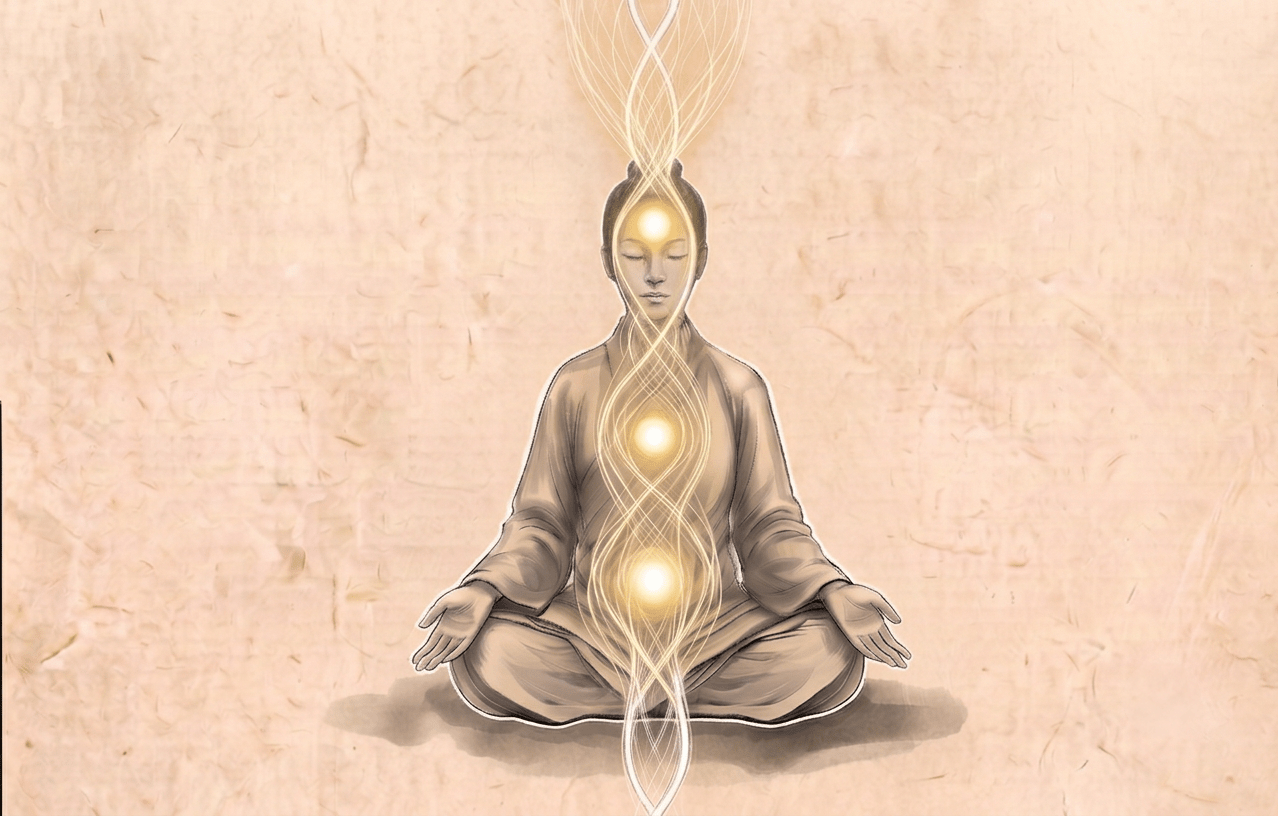
Once a healthy cycle of practice through the three phases is established, the three treasures gradually come into balance and the energetic system continues through a kind of maturation. As this occurs we may find new phases of practice beginning to manifest, such as development of the central channel or the conduction of universal energies.
These developments are best met as they arise rather than sought, and taken up in conversation with a teacher. Pursuing them ahead of a stable foundation in the three phases tends to produce strain rather than progress.
Post-Practice
When a formal practice session ends, take a moment to sincerely express gratitude to the Buddha and to share the merit of practice for the benefit of all beings.
Place the hands overlapping comfortably, palms facing the body, over the primary dantian we have been working with, and simply feel and appreciate the sensations there for three to thirty-six breaths. This helps the attention, qi, and body response find their way back to the natural reservoirs in these areas.
Then conclude the session with a gentle massage of the body from the top down. This massage is moving touch that leads attention, energy, and spirit downward through the body; see the note in “Keep Attention Out of the Head.”
- Rub the palms of the hands together until warm.
- Place the palms over the eyes and warm them.
- Massage the area around the eyes.
- Massage the temples, forehead, and scalp.
- Massage the back of the head, then the back and sides of the neck.
- Massage one shoulder, upper arm, elbow, lower arm, wrist, hand, and fingers, then the other.
- Massage the chest, solar plexus, and stomach.
- Massage the back and lower back.
- Massage one hip, upper leg, knee, lower leg, ankle, and foot, then the other.
Think of this closing as a kind of spiritual hygiene that helps develop and mature wise intentions, closes the practice, and returns us to ordinary activity.
Linked below is an interview on the Awakening Alchemy system courtesy of our Dharma friends at Clear Mountain Monastery Project.
© 2026 Jason Bartlett · Luminous Dharma · luminousdharma.org